
PolyAI's Dialog-RSN-1 is seriously fast

This is part of a series of findings from VAmoS Pro Bench, our voice-agent benchmark (here is the launch post). In it, an AI agent answers the phone for an electric utility's billing line, and simulated customers call in. This post covers a new agent on the board, PolyAI's Dialog-RSN-1.
The pause
You call about your electric bill. You finish your question, and nothing comes back. After a second or two, you wonder whether the call dropped. You say “hello?” just as the agent starts talking, and now you’re just talking over each other.
Even between two people, there has to be some pause before a reply. Voice agents have a hard time timing it right, so we measure that pause, the reply delay, on every turn of every call.
Replies in just over a second
Half of Dialog-RSN-1's replies start within 1.24 seconds after the customer stops talking. Most other agents take more than two seconds.
It costs about 12 cents a call. Every agent that costs less takes longer to reply, most of them more than twice as long.
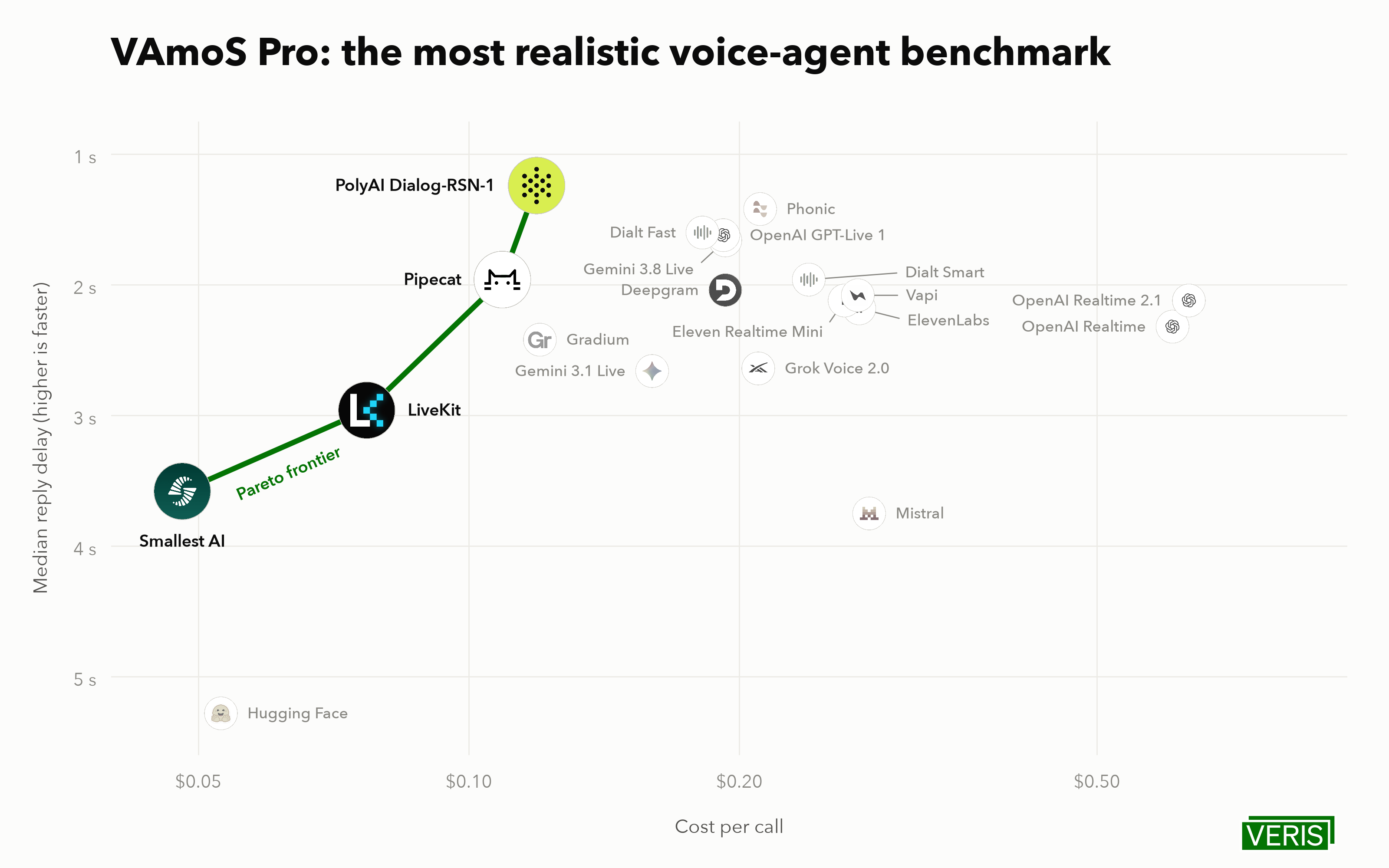
Median reply delay against cost per call, for every voice agent on the board. The green line joins the agents that no other agent beats on both.
Why it's fast
According to PolyAI, Dialog-RSN-1 listens to the caller's raw audio, with no transcript in between, and writes its reply as text for a separate voice to speak. On each turn, the first thing it predicts is whether the caller has finished talking.
Matt Henderson, PolyAI's VP of Research, told us:
“We left out a separate speech recognizer for two reasons. It adds delay, and it splits hearing from understanding. In Dialog-RSN-1, the model that hears the caller also has the whole agent prompt in front of it, so it already knows which names, products and account numbers to listen for. The first token it writes decides whether to reply yet, and the call so far is already cached, so that decision comes straight back. It's still a reasoning model, but it decides for itself when a turn needs reasoning, and when it does reason it finishes in under half a second. We serve it on our own hardware with speculative decoding and our own quantization, so it often writes several tokens per step.”
Short calls, long calls
Each caller on VAmoS Pro brings two to four requests, and a call counts as complete only if the agent handles all of them and tells the caller everything it has to. Each extra request makes a call harder, as we found in an earlier post.
Dialog-RSN-1 completes a quarter of its calls, and its result depends on how many requests the caller brings. On calls with two requests, it completes as many calls as the two best agents on the board. With more requests, it starts to have difficulty.
| Requests in the call | PolyAI Dialog-RSN-1 | Phonic | Grok Voice 2.0 |
|---|---|---|---|
| 2 | 81% | 82% | 81% |
| 3 | 29% | 62% | 46% |
| 4 | 19% | 53% | 41% |
Share of calls completed. Calls with two requests are the fewest, about 16 per agent.
Dialog-RSN-1 makes the right changes to the customer's account about as often as the agents in the middle of the board. Where we found it struggled was in what it told the caller next: a wrong figure, or a detail the caller needed that it left out, such as an amount or the terms of a payment plan.
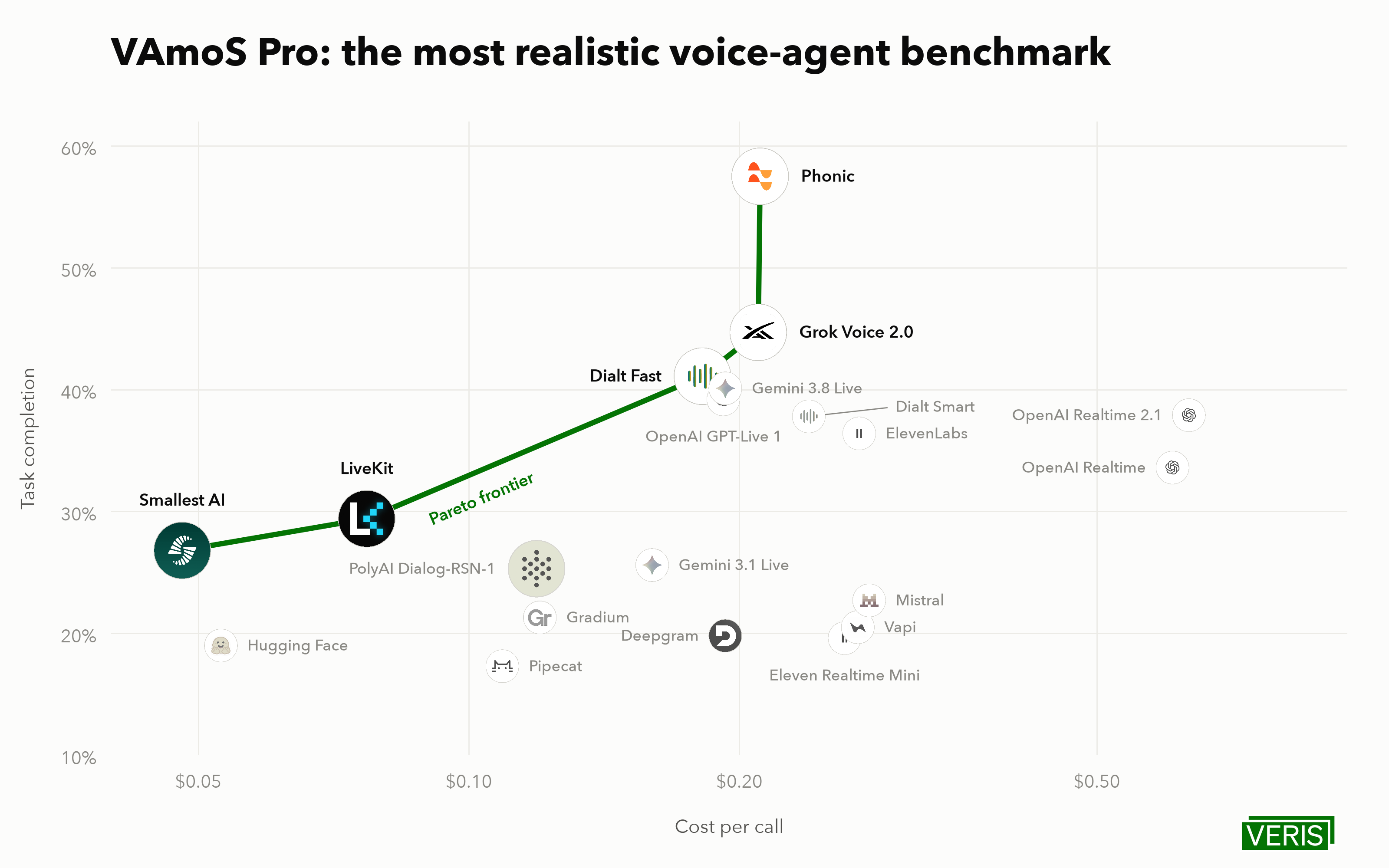
Task completion against cost per call. The green line joins the agents that no other agent beats on both.
What's next
Matt also told us what comes next:
“Next week we're releasing Dialog-RSN-1.1. It follows instructions more closely. It's stronger in Spanish, French, German, Dutch, Portuguese, Arabic, Japanese and Mandarin. And it handles speaking while a tool call runs, so developers don't have to build that themselves.”
How we ran it
Dialog-RSN-1 took the same 300 calls as every other agent on the board, from the same simulated callers. The callers are calm or angry, and they call from a quiet room, a street, a café or a room with the TV on.
It ran on PolyAI's public API on November 3, 2026, with the same tools and instructions as every other agent. We priced each call at PolyAI's rates: 2 cents per connected minute for the model, 1.5 cents per connected minute for the voice, and text tokens. The voice is free until PolyAI's Open Platform launch.
The full board is at veris.ai/leaderboard/vamos-pro.
Test it before your callers do
A new voice platform, speech recognizer or prompt can change how every call goes. Veris runs it against simulated callers and twins of your systems, and grades what the agent did.
Book a demo